

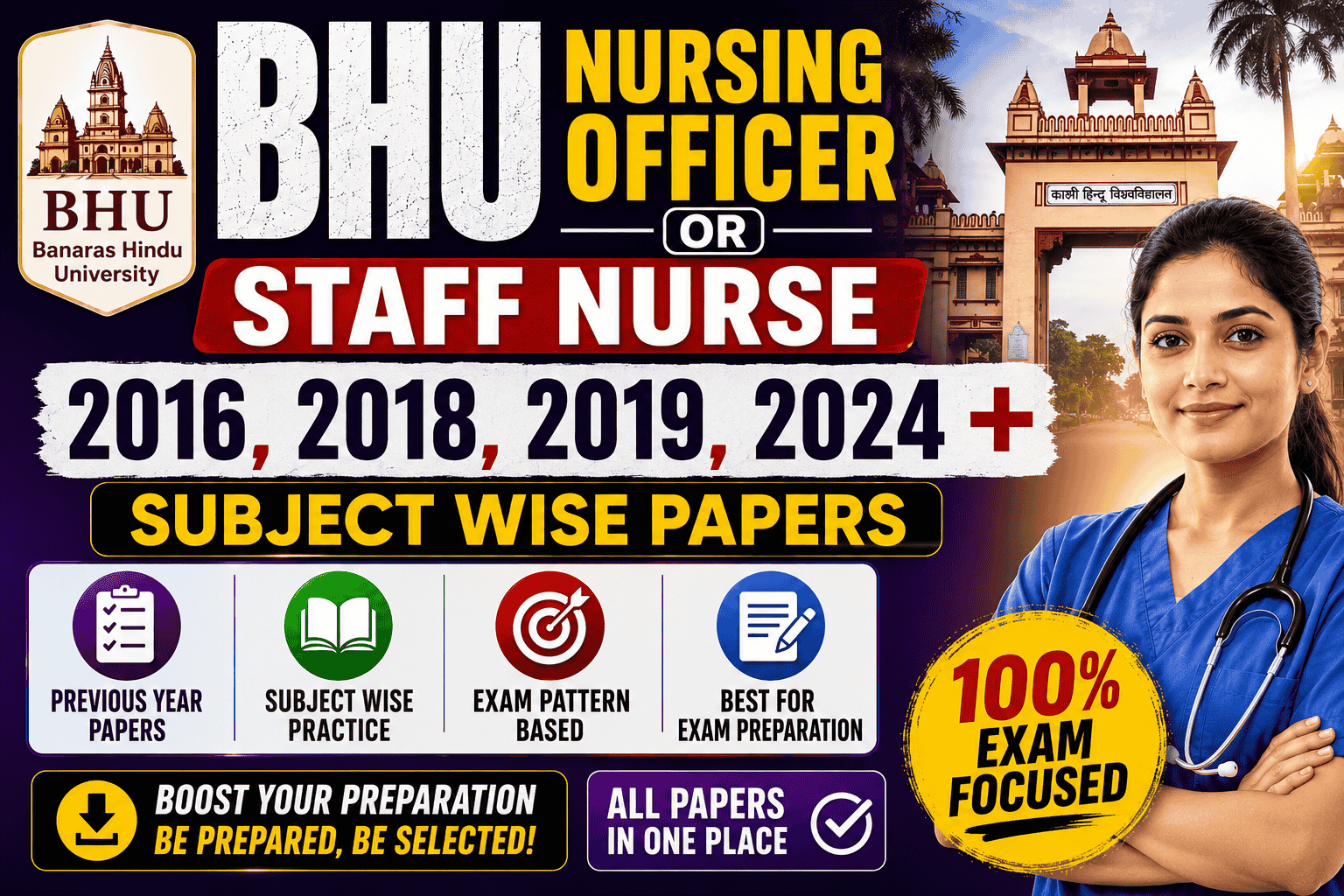
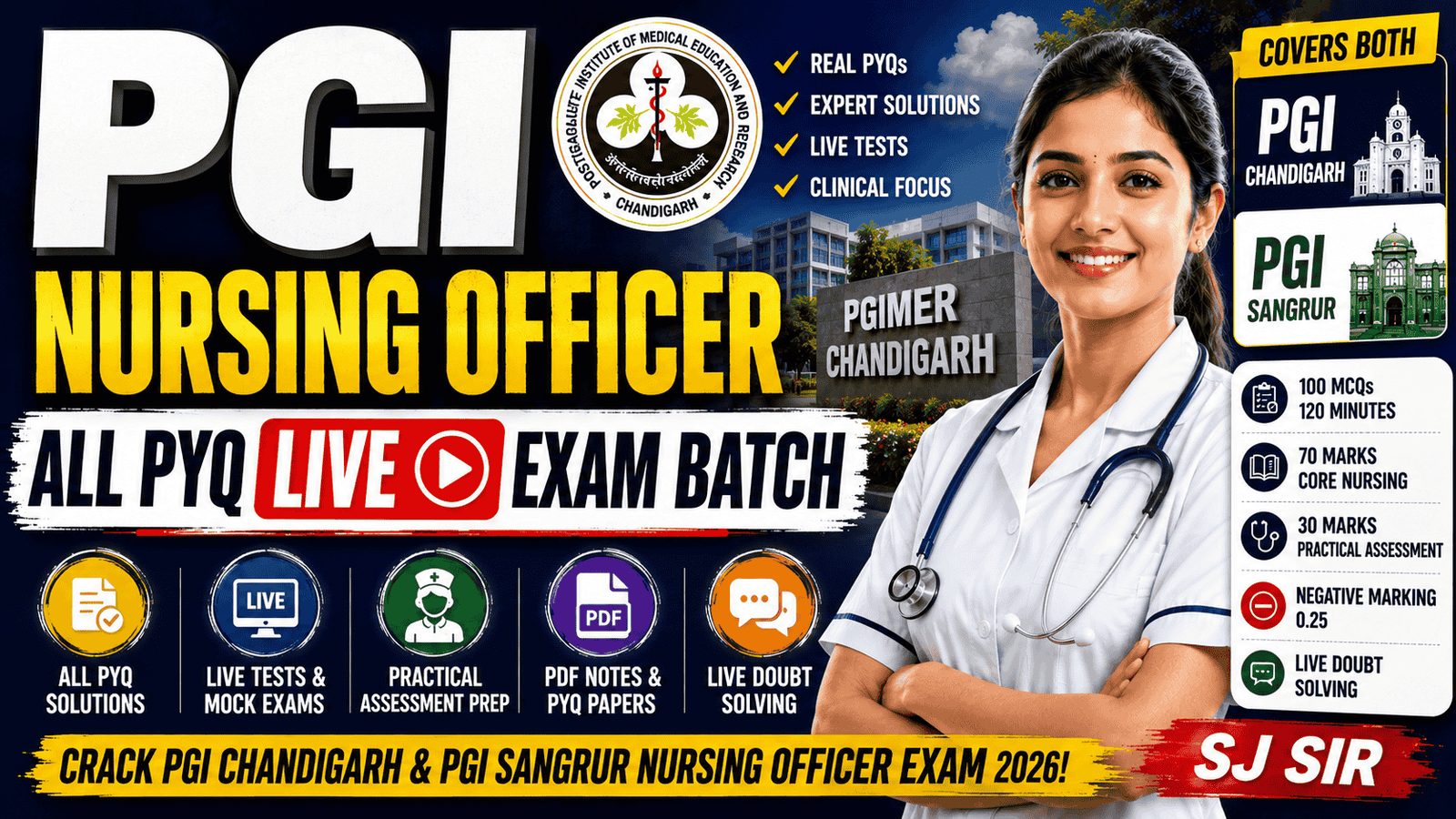
BHU NURSING OFFICER - All PYQ Live Exam Batch
Admin
What Will You Learn?
About This Course
🌟 Overview
Welcome to the most comprehensive and specialized BHU NURSING OFFICER - All PYQ Live Exam Batch, designed meticulously for aspiring nursing professionals aiming to crack national-level examinations. Conducted by Banaras Hindu University (often through NTA) and competitive bodies like AIIMS NORCET, RRB, and ESIC, securing a Nursing Officer position requires more than just reading textbooks—it demands a strategic mastery of Previous Year Questions (PYQs), rapid analytical thinking, and time management.
In this live interactive batch led by SJ Sir, we break down past years' question papers (2019–2024) question-by-question. Using a bilingual teaching approach (a blend of simple Hindi and English), every question is dissected with complete evidence-based rationales, helping you master not just the correct option, but also why the remaining options are incorrect. Get ready to transform your preparation into confirmed selection!
🎯 What You Will Get
- Daily Live PYQ Discussions: Interactive, in-depth problem-solving sessions covering technical nursing and general aptitude sections.
- 360° Option Rationale Analysis: Learn elimination techniques and root-concept explanations for over 3,000+ high-yield MCQs.
- Downloadable PDF Notes & Study Sheets: Quick-revision summary sheets, tabular data, and annotated lecture PDFs after every class.
- Exam-Pattern Mock Test Series: Timed practice quizzes and full-length simulated tests designed strictly according to the latest NTA/BHU and NORCET marking schemes.
- Dedicated Doubt Clearing & Forum Access: 24/7 access to the student discussion forum to get your academic queries answered directly by SJ Sir and peer mentors.
- 1-Year Unlimited Access: Re-watch recorded lectures anytime, anywhere on your mobile, tablet, or desktop.
👩⚕️ Who Should Join
- BHU Nursing Officer Aspirants: Candidates targeting upcoming NTA/BHU Staff Nurse and Nursing Officer vacancies.
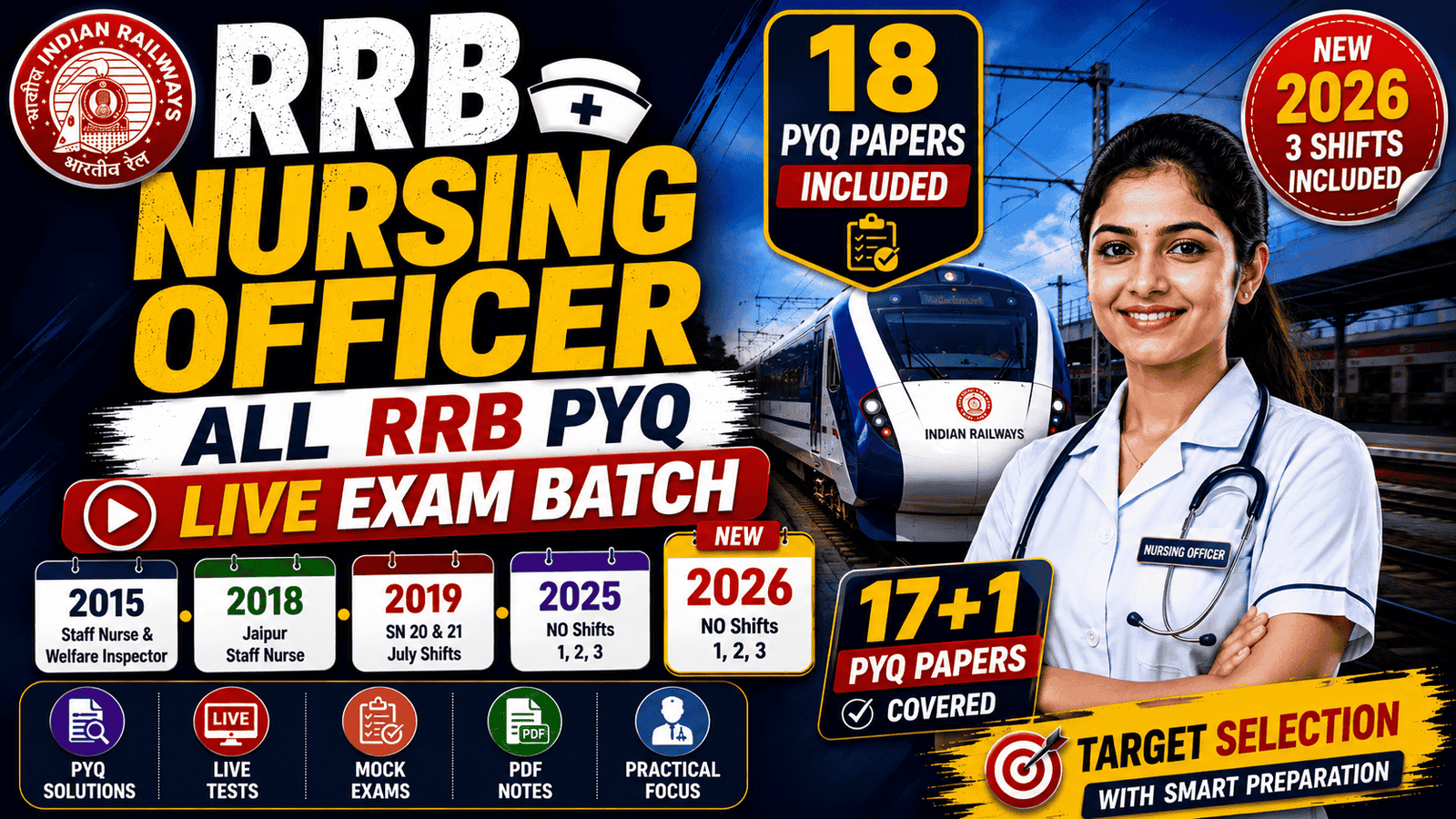
- AIIMS NORCET & RRB Aspirants: Nursing graduates preparing for AIIMS NORCET, Railway Recruitment Board (RRB) Staff Nurse, ESIC, and UP NHM exams.
- B.Sc. Nursing & GNM Graduates: Fresh graduates or experienced nurses seeking a structured, high-yield practice batch to boost their exam accuracy.
- Repeaters Seeking Score Boost: Students who missed previous cut-offs due to negative marking or weak aptitude/GK preparation.
🗺️ Study Plan / Roadmap
- Phase 1: Foundation & Core Subjects Drill (Weeks 1–4): Intensive PYQ solving for major weightage subjects: Medical-Surgical Nursing (MSN), Fundamentals of Nursing (FON), and Pharmacology.
- Phase 2: Specialty & Clinical Subjects (Weeks 5–8): Targeted PYQ breakdowns for Obstetrics & Gynaecology (OBG), Pediatric Nursing, Psychiatric Nursing, and Community Health Nursing (CHN).
- Phase 3: Part-B Aptitude & GK Booster (Weeks 9–10): Dedicated sessions focusing on General Awareness, Quantitative Aptitude, Logical Reasoning, and Basic English Grammar to maximize scoring in non-nursing sections.
- Phase 4: Mega Mocks & Exam Simulation (Weeks 11–12): Full-length timed mock tests, previous year paper marathons (2019–2024), and live doubt-clearing webinars before exam day.
📊 Exam Pattern & Syllabus Highlights
Based on the latest official notification trends and NTA/BHU examination patterns, the exam structure evaluates both technical acumen and general aptitude:
- Exam Mode: Offline (OMR-based) or Computer-Based Test (CBT), depending on the specific recruitment cycle.
- Sectional Division: Generally divided into two crucial sections:
- Part A (Technical Nursing): Covers core nursing subjects (Anatomy & Physiology, MSN, FON, OBG, Pediatrics, CHN, Mental Health, Pharmacology, and Nursing Management). Holds the majority weightage (approx. 60%–75% of total questions).
- Part B (General Aptitude & Awareness): Evaluates General Knowledge, Current Affairs, Numerical Ability/Aptitude, Logical Reasoning, and Basic English (approx. 25%–40% of total questions).
- Marking Scheme: Objective Multiple Choice Questions (MCQs). Highly competitive marking structure typically awarding +4 marks for each correct answer and imposing a negative marking of -1 or -2 marks for incorrect answers.
- Time Duration: Typically 120 to 180 minutes, requiring rigorous speed and accuracy practice.
⚠️ Disclaimer
This course is intended strictly for educational and competitive examination preparation purposes only. The course materials, lectures, PYQ discussions, and practice questions do not constitute professional medical advice, clinical diagnosis, or patient treatment instructions. Always follow official healthcare protocols and institutional guidelines for actual clinical practice.
Requirements

Trusted Companies
+3200 Companies trusted our courses for their staff tutoring
SJ Sir
Related Courses
Explore newly published courses and stay updated.
Curriculum Overview
This course includes 1 modules, 24 lessons, and 0 hours of materials.
Quiz Certificate
Course Certificate
This Course Includes
Course Specifications
Tags
Subscribe to Our Newsletter


Additional Links
Login Register Contact Certificate Validation About Privacy Policy Terms and Policies Refund PolicyContact US


Reply to Comment